
You learn that light shapes your evening calm by signaling your brain’s clock to suppress melatonin and delay its release. Bright or blue-enriched light late in the day shifts when you feel ready to wind down, nudging your sleep onset later. Dim, warm lighting and lower blue exposure help your clock release melatonin sooner, aligning your evening cues with actual wind-down time. The pattern matters for steady evenings—and for what comes after, if you stay curious.
Key Points
- Light timing regulates melatonin release via pathways from the retina to the suprachiasmatic nucleus, shaping evening calm and sleep readiness.
- Evening bright or blue-enriched light delays melatonin, pushing sleep onset later and reducing perceived calm at bedtime.
- Dimmer, warm lighting 2–3 hours before bed accelerates melatonin timing and promotes a smoother sleep onset.
- Controlling intensity and spectrum (low blue, 2700–3000K) reduces alertness and enhances sleep cue alignment with a set bedtime.
- Practical strategies (night mode, blue-blocking filters) help maintain evening calm by minimizing disruptive light exposure.
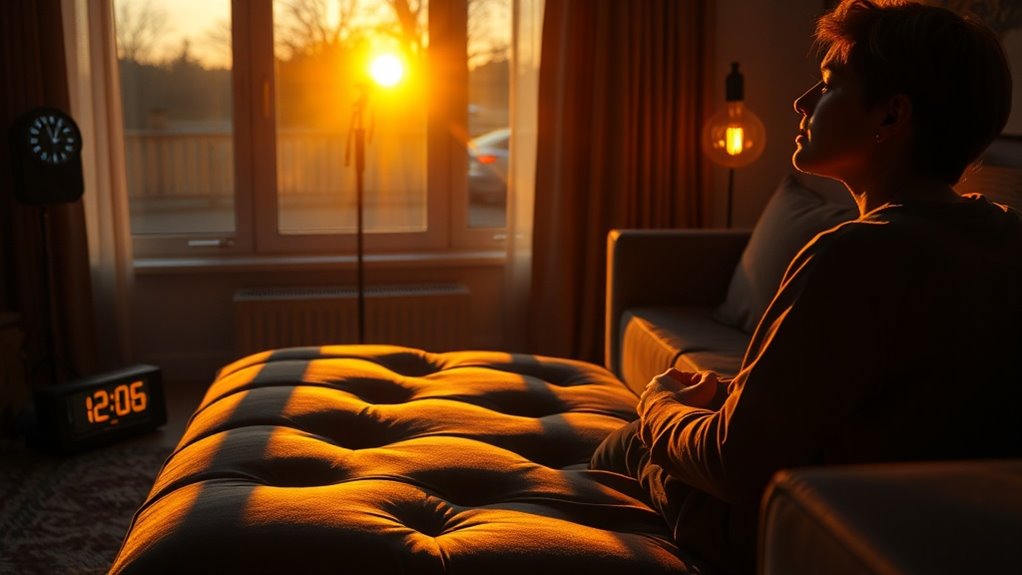
Evening calm and light exposure matters more than you might expect. You’ll find that light in the hours before bed is not a cosmetic variable but a chemical signal that shapes your brain’s preparation for sleep. In practical terms, you can track how varying brightness and color temperature influence your ability to settle, then relate that to measurable outcomes like how quickly you fall asleep, how long you stay asleep, and how rested you feel in the morning. The mechanism is straightforward: light suppresses melatonin production through the retinal pathways that project to the suprachiasmatic nucleus, the brain’s master clock. When you expose yourself to bright or blue-enriched light too late, melatonin timing shifts later, nudging sleep onset toward a later hour. Conversely, reducing light exposure, especially blue light, before you intend to sleep supports earlier melatonin release and a clearer transition to sleep.
Evening light shapes sleep timing, guiding melatonin and bedtime cues.
You’ll notice the practical pattern once you separate ambient cues from deliberate behaviors. If you work late under a bright desk lamp or scroll on a backlit screen, you’ll experience later sleep cues, a delayed taper of alertness, and a longer time to fall asleep. In contrast, dimming lights in the 2 to 3 hours before bed tends to advance sleep cues and compress the window between bedtime and sleep onset. This timing alignment matters because it constrains your circadian phase, which in turn influences sleep duration and perceived sleep quality. The result is not mystical; it’s an interplay of light-induced melatonin timing and your intentional wind-down routine.
To apply this empirically, you can quantify exposure by controlling two variables: intensity and spectrum. You should aim for lower intensity after about two hours before bed and prefer warmer color temperatures, roughly 2700–3000 Kelvin, to minimize blue-enriched stimulation. If your evening tasks require light, consider blue-blocking filters or lenses, or switch to lighting that has minimal short-wavelength output. When you must use bright screens, enable night mode and set a hard offline cutoff at a consistent hour. Such steps help stabilize sleep cues and reduce variability in sleep onset across nights.
Track your outcomes with simple notes: estimate how long it takes you to fall asleep, how many times you awaken, and your morning clarity. If you consistently see delayed sleep onset after periods of bright evening light, incrementally reduce exposure or shift to warmer light earlier. If you experience earlier onset with dimmer, warmer evenings, you’ve aligned your melatonin timing with your desired bedtime. In short, evening light exposure directly scales your calm at night by shaping sleep cues and melatonin timing, yielding more predictable sleep and more consistent mornings.
Frequently Asked Questions
How Quickly Does Light Exposure Affect Sleep Onset?
Light exposure can change sleep onset within about 30 to 60 minutes, though individual timing varies. When you’re exposed to bright, blue-rich light, your rapid circadian shift accelerates, and melatonin suppression begins, reducing sleepiness. In practical terms, avoid screens or bright lighting for at least an hour before you plan to sleep. If you must, use dim, warmer light and consider contrast with your daytime exposure to optimize onset timing.
Do Screens Emit Blue Light in All Colors?
Screens don’t emit blue light in all colors. They emit blue-enriched light and other wavelengths; blue light is a component, not a color across the spectrum. Your color perception varies with wavelength, and screens often mix hues to create white or colored images. So, while blue light is present, it isn’t the sole color emitted. You’ll still perceive a broad spectrum, shaped by color perception and display technology.
Can Dim Lighting Improve Alertness at Night?
Dim lighting can reduce nighttime alertness; it generally won’t boost it. If you’re trying to sleep, you’d be better off lowering brightness to promote rest. Yet, a brief, dimly lit window of activity might spike attention momentarily if you’re adapting to darkness—a coincidence of environment and timing. You’ll notice that dim lighting signals your body to wind down, whereas bright or blue-rich light suppresses melatonin and hinders nighttime alertness. For calm evenings, dim lighting supports sleep-friendly goals.
Does Natural Sunlight Differ From Artificial Light Timing?
Yes, natural sunlight differs from artificial timing in impact and predictability. You’ll get broad-spectrum cues outdoors at precise times, especially morning and midday, which strongly influences your circadian rhythm. Artificial timing, by contrast, depends on device settings and can be misaligned with natural cycles, delaying melatonin. You should prioritize natural sunlight exposure when possible, while using artificial lighting to align with your schedule, avoiding late-evening blue light for better sleep.
What Light Intensity Is Safest Before Bedtime?
You’ll find that safe lux levels before bed are low, typically under 30–50 lux for most sleepers. Calming melatonin rises as light fades, guiding you toward sleep. Empirically, dimmer is better; avoid bright screens and overheads. You’ll notice that stable, low-intensity lighting supports delayed melatonin suppression and smoother sleep onset. If you must read, use a warm, dim light. Overall, calibrate to the lowest effective intensity to maximize calming melatonin and restful sleep.